
6 min read
Frozen and burst pipes: prevention, safe thawing, and cleanup
By the Strauss Cleaners crew·Updated September 2, 2026
Every January the calls come in the same order: a pipe in an exterior wall freezes overnight, thaws by afternoon, and the split in it lets go while nobody is home. Here is where they freeze, how to prevent it, how to thaw one safely, and what to do if it has already burst.
Short answer
Pipes freeze in exterior walls, crawlspaces, garages, and unheated additions. Keep the house above 55 degrees, open cabinet doors under sinks on outside walls, and drip a faucet during a deep cold snap. Thaw with a hair dryer starting at the faucet end, never an open flame. If a pipe bursts, close the main shutoff, open the faucets, and call for drying the same day.
Where pipes freeze in our houses
The pipes that freeze are the ones that run where the heat does not. Supply lines in exterior walls, especially under kitchen and bathroom sinks on an outside wall. Lines through an unheated crawlspace, garage, or attic. Pipes in a cantilevered bay or a room over a porch. Hose bibs with a hose still connected. Additions built over a slab with no insulation under it. A finished basement with the heat registers closed to save money is a common one too.
Older Hudson Valley and North Jersey housing has all of these. The 1950s cape with a kitchen addition, the split-level with the family room over the garage, the pre-war house with a crawlspace under the back half.
Preventing it
None of this is expensive.
- Keep the thermostat at 55 degrees or higher when you are away, including overnight and on vacation. Turning the heat down to 45 to save on a weekend trip is how most burst-pipe calls start.
- Open the cabinet doors under sinks on exterior walls during a cold snap so room air reaches the pipes.
- Let a faucet on the far side of the house drip during the coldest nights. Moving water is much harder to freeze.
- Disconnect garden hoses and, if you have interior shutoffs for the hose bibs, close them and drain the bibs.
- Insulate exposed pipes in the crawlspace, garage, and attic with foam sleeves. Seal the gaps around where pipes pass through exterior walls.
- Know where the main water shutoff is and check that it turns. Show everyone in the house.
- If you leave for more than a few days in winter, shut the main and open a faucet to relieve pressure, or have someone check the house daily. Some policies require one or the other.
Thawing a frozen pipe safely
If a faucet gives you a trickle or nothing on a cold morning, a pipe feeding it has frozen. Open that faucet first, so melting ice has somewhere to go and pressure does not build against the blockage. Then warm the pipe starting at the faucet end and working back toward the frozen section, with a hair dryer, a heating pad wrapped around the pipe, or towels soaked in hot water. Keep the faucet open and be patient.
Never use a torch, a heat gun on high, or any open flame. Pipes in walls sit next to framing and paper-faced insulation, and the fire calls that start this way are not rare. If you cannot find the frozen section, or it is inside a wall, call a plumber. Do not open the wall yourself.
A pipe that froze and thawed once will freeze again in the same spot. Fix the reason it froze before the next cold snap.
When it bursts
Frozen water expands and splits the pipe, but the leak usually starts when it thaws. Close the main shutoff immediately. Open the faucets in the house to drain the lines and relieve pressure. If water is near outlets, the panel, or light fixtures, shut off the affected breakers. Then photograph the leak point and everywhere the water reached before you start moving furniture.
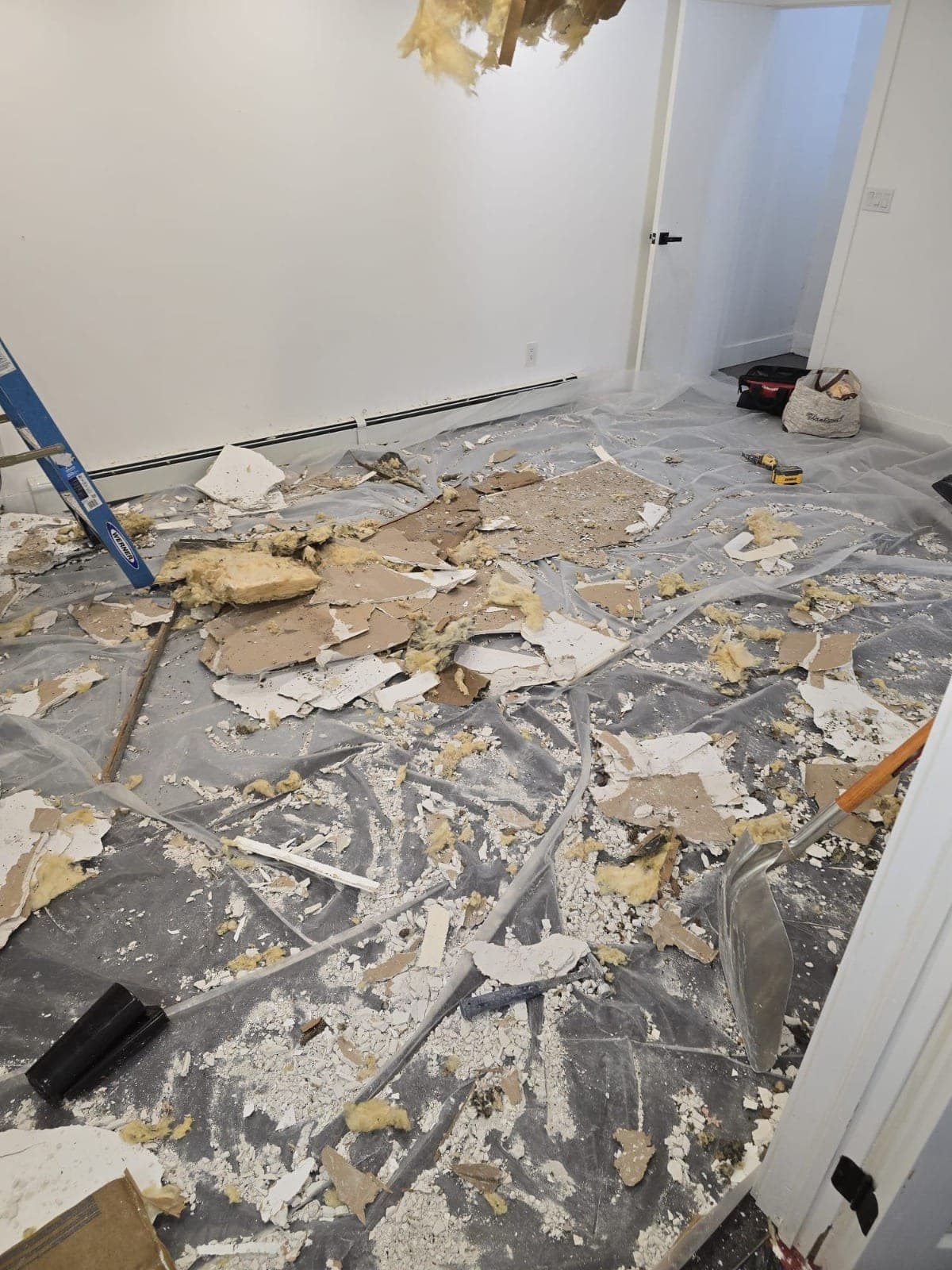
The pipe repair is a plumber's job. The drying is ours. Water from a burst supply line is clean, but it soaks insulation, drywall, subfloor, and ceilings fast, and those materials grow mold within days if they stay wet. We extract standing water, open wet ceilings and walls where needed, and run air movers and dehumidifiers with daily moisture readings until the structure reads dry.
Coming home to it
The worst version is the pipe that let go on a Tuesday while the house was empty until Sunday. Water ran for days, through the ceiling, down the walls, into the basement. If that is what you walked into, the order is the same: main shutoff, breakers, photos, then call. Do not run the furnace fan to dry things out. It moves damp air and spores through the whole house. Our first 24 hours guide covers what to do in the meantime.
Insurance and the heat clause
Insurers generally treat a burst pipe as a sudden and accidental loss. Many policies add a condition, though: you have to have maintained heat in the house, or shut off and drained the water, while it was unoccupied. Read that clause before winter or ask your agent about it, because a claim on a house left at 40 degrees with the water on is the one that gets argued, and how it comes out is your insurer's decision. We document the cause and bill carriers directly on covered claims, and a claim is not required to hire us.
If a pipe has burst, call now. Same-day emergency response, six days a week, and the inspection is free.
Related service
Burst Pipe Cleanupin the Hudson Valley & North Jersey →Cleanup and drying for burst and frozen pipes, plus the appliance failures that cause most indoor floods: washing machine hoses, water heaters, dishwasher and fridge lines. We trace, dry, document, and rebuild.
Not sure what you're looking at?
Same-day emergency response for active water, Sundays included.