
6 min read
The first 24 hours after water damage, hour by hour
By the Strauss Cleaners crew·Updated July 28, 2026
The first day usually decides whether this stays a drying job or turns into a demolition job. Here's what those 24 hours should look like, in order, including the parts you can handle yourself before a crew arrives.
Short answer
Keep people away from water that could be electrically live or contaminated, shut off the source, and get standing water extracted the same day. Drying equipment should be running within 24 hours; mold can start growing on wet materials in as little as 24 to 48 hours.
Minute one: check for hazards
Two safety checks before anything else. First, electricity. A flooded room with live outlets, power strips on the floor, or a submerged appliance can kill you. If the breaker panel is dry and you can reach it without stepping through water, shut off power to the affected rooms. If reaching the panel means walking through water, stay out and call your utility company or an electrician.
Second, the water itself. If it's coming from a drain, a toilet backup, or rising in from outside, treat it as contaminated and keep kids and pets out of the area entirely. Sewage-tainted water is a health hazard, and it needs sewage cleanup protocols and protective gear rather than a mop and household gloves.
The first 15 minutes: shut off the source
For a burst pipe or failed appliance line, closing the main water valve is worth more than anything anyone does afterward. In most homes around here it's where the water line enters, usually the basement wall facing the street or near the water heater. Turn it clockwise until it stops. If a single fixture or appliance is the problem, the small shut-off valve behind it may be enough.
If you can't find the valve, call anyway. Walking a homeowner to their main shut-off while the crew loads the truck is a normal part of our emergency calls. The damage keeps adding up for as long as the source is running.
Hour one: call for help, then move what you can
With the source stopped, make two calls: a restoration company, then your insurance carrier. While the crew is on the way, move electronics, documents, and anything irreplaceable out of the wet area. Get furniture legs off wet carpet and onto foil or blocks; wood stain and metal feet bleed stains into wet carpet within hours.
This is also when to photograph everything: the source, the standing water, the water line on the walls, contents where they sit. That documentation is what your claim runs on later, and the full walkthrough is in our guide to water damage insurance claims.
Hours one to eight: the extraction window
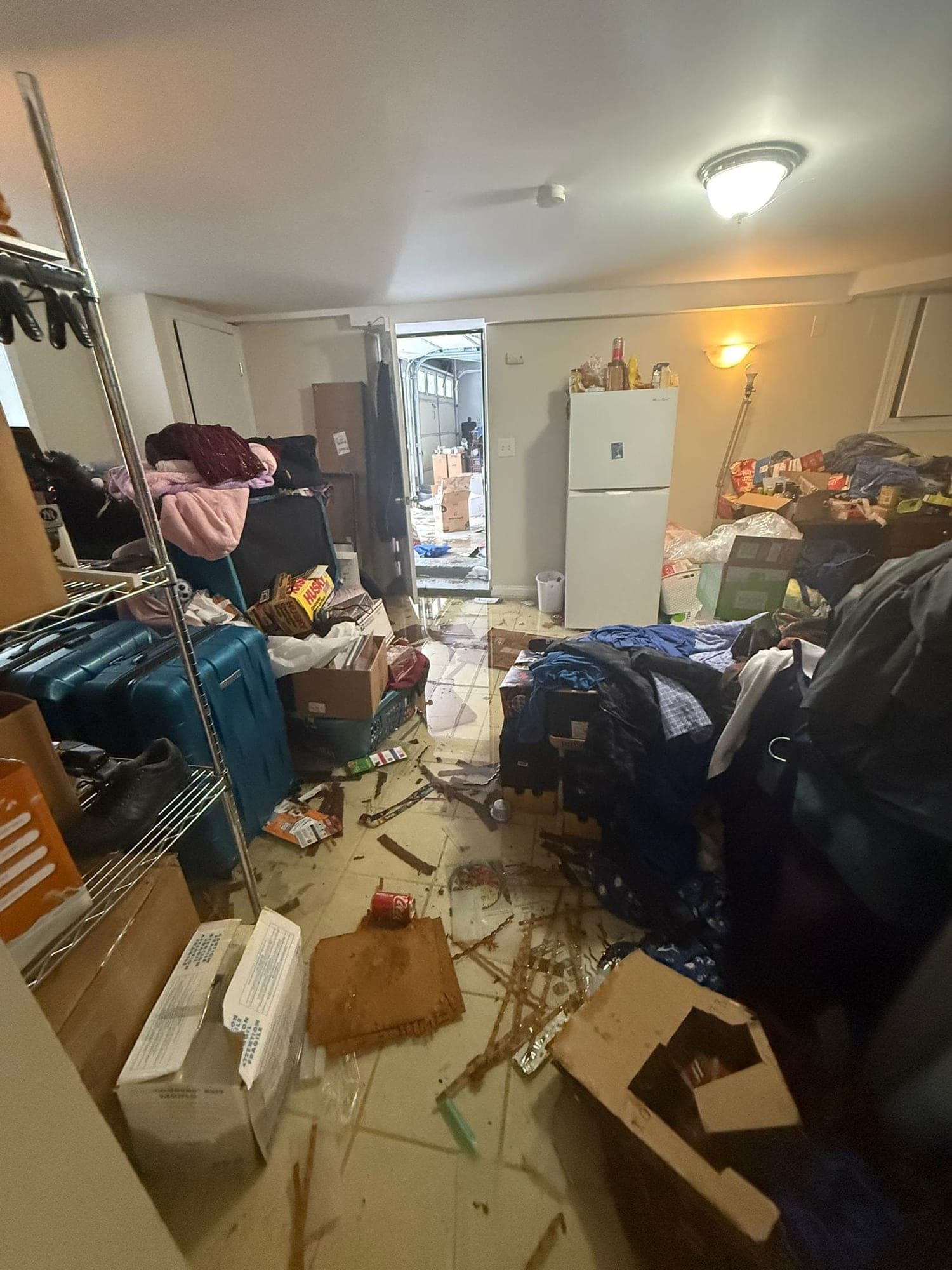
Standing water needs to come out mechanically, and the sooner the better. Water pulled out now is water that doesn't soak into the pad, the subfloor, and the bottom plates of the walls. This is where a truck-mounted extractor beats a shop vac: it pulls water up through carpet and pad rather than skimming the surface, and it does a whole floor in the time a wet vac does a corner.
A shop vac is still worth running while you wait, but it only takes off surface water. Carpet that feels damp instead of soaked is still holding gallons you can't feel, which is why emergency water removal follows extraction with moisture meters instead of a hand test.
Hours eight to twenty-four: drying starts
By the end of day one, drying equipment should be down and running: air movers pushing air across wet surfaces, dehumidifiers pulling moisture out of the air so it doesn't just migrate to the next room. Saturated pad, swollen baseboard, and other materials that can't be saved should already be out. They don't dry in place; they hold moisture against everything around them.
The first 24 hours won't finish the job. Structural drying typically runs several days, with daily meter readings, because subfloor, framing, and drywall release moisture far more slowly than air does. A floor that feels dry on day two is not the same as a structure that reads dry on a meter, and the meter is what we go by.
Mold risk: 24 to 72 hours
This is the reason for the urgency. Per EPA guidance, mold can begin growing on wet materials in as little as 24 to 48 hours, which is why the EPA advises cleaning and drying anything wet within that window. A house that stayed wet for three days isn't automatically moldy, but the odds get worse with every day materials stay damp.
It's also why extraction and drying are same-day work rather than a Monday appointment. If your water damage is already days old, the job changes from prevention to assessment: get the moisture mapped, and if growth has started, handle it as mold remediation. A musty smell does not air out on its own.
What not to do
Some well-meant moves make a water loss worse. These are the ones we see most:
- Don't run the furnace fan or ceiling fans to 'help dry' contaminated water. Moving air over sewage-tainted surfaces spreads the problem.
- Don't crank the heat. Warm, humid air is good growing conditions for mold, and heat alone moves moisture around instead of removing it.
- Don't rip out wet materials before photographing them. You're throwing away claim evidence.
- Don't put a couple of box fans on soaked carpet and call it done. Dry-feeling carpet over a wet pad is where the musty smell a week later comes from.
- Don't poke a bulging ceiling over your furniture. Relieve it in a controlled spot or wait for the crew.
- Don't wait for the adjuster before starting mitigation. Carriers expect you to prevent further damage, and a drying delay can count against the claim.
One number to have ready
Our line answers 8am to 6pm, Sunday through Friday (closed Saturdays for Shabbat), and same-day response means extraction usually starts within hours. Save (845) 262-6530 in your phone before you need it.
Related service
Emergency Water Removalin the Hudson Valley & North Jersey →Rapid water extraction with same-day dispatch, six days a week. Truck-mounted extractors and submersible pumps pull standing water out fast, and drying equipment goes down the same visit.
Not sure what you're looking at?
Same-day emergency response for active water, Sundays included.